• Price Trending B.F. Calculator Testimonials
  • 1-877-983-6367
Logo
  • Slabs
    • Featured
      • Walnut Slabs
      • White Oak Slabs
      • Large Live Edge Tabletop Slabs
      • Discount Slabs
      • *Latest Live Edge Slab Kiln Drop
      • River Table Slabs
    • Short Slabs and Rounds
    • Ambrosia Maple Slabs
    • Aromatic Red Cedar Slabs
    • Ash Slabs
    • Black Gum Slabs
    • Cherry Slabs
    • Curly Maple Slabs
    • Cypress Slabs
    • Elm Slabs
    • Hard Maple Slabs
    • Hickory Slabs Live Edge
    • Katalox Slabs
    • Kentucky Coffee Tree Slabs
    • Mango Slabs
    • Mappa Burl Slabs
    • Myrtlewood Slabs
    • Osage Orange Slabs
    • Padouk Slabs
    • Parota Slabs
    • Pecan Slabs
    • Poplar Slabs
    • Red Elm Slabs
    • Red Mulberry Slabs
    • Red Oak Slabs
    • Redwood Slabs and Burls
    • Sipo Mahogany Slabs
    • Soft Maple Slabs
    • Spalted Ash Slabs
    • Spalted Hackberry
    • Spalted Maple Slabs
    • Spalted Sycamore
    • Sycamore Slabs
    • White Pine Slabs
    • Bases
  • Lumber
    • Exotic Lumber for Sale
    • African Mahogany Lumber
    • Afrormosia Lumber
    • Alder Lumber
    • Aniegre Lumber
    • Aromatic Cedar Lumber
    • Ash Lumber
    • Avodire Lumber
    • Beli Lumber
    • Bloodwood Lumber
    • Bocote Lumber
    • Bosse Lumber
    • Bubinga Lumber
    • Butternut Lumber
    • Canarywood Lumber
    • Caribbean Rosewood
    • Cherry Lumber
    • Chestnut Lumber
    • Cocobolo Lumber
    • Cumaru Lumber
    • East Indian Rosewood
    • Edinam Lumber
    • Granadillo Lumber
    • Guatemala Rosewood
    • Hard Maple Lumber
    • Hickory Lumber
    • Honduras Rosewood
    • Ipe Lumber
    • Iroko Lumber
    • Jatoba Lumber
    • Koa Lumber
    • Leopardwood Lumber
    • Limba Lumber
    • Macassar Ebony
    • Mahogany Lumber
    • Makore Lumber
    • Marblewood Lumber
    • Morado Lumber
    • Myrtlewood Lumber
    • Nogal Lumber
    • Obeche Lumber
    • Padouk Lumber
    • PC Maple Lumber
    • Purpleheart Lumber
    • Red Elm Lumber
    • Red Grandis Lumber
    • Red Oak Lumber
    • Redheart Lumber
    • Santos Mahogany Lumber
    • Sapele Lumber
    • Shedua Lumber
    • Sipo Lumber
    • Soft Maple Lumber
    • Spanish Cedar Lumber
    • Teak Lumber
    • Walnut Lumber
    • Wenge Lumber
    • White Oak Lumber
    • Rift White Oak Lumber
    • Yellow Birch Lumber
    • Yellowheart Lumber
    • Zebrawood Lumber
    • Zebrawood, Red Ebiara
  • Mouldings-S4S
    • Dimension
      • African Mahogany Dimension
      • Alder, Knotty Dimension
      • Alder, Superior Dimension
      • Ash Dimension
      • Birch Dimension
      • Cherry Dimension
      • Douglas Fir Dimension
      • Hard Maple Dimension
      • Mahogany Dimension
      • Poplar Dimension
      • Red Grandis Dimension
      • Red Oak Dimension
      • Sapele, Flat Sawn Dimension
      • Sapele, Ribbon Dimension
      • Sipo Dimension
      • Soft Maple Dimension
      • Spanish Cedar Dimension
      • Teak Dimension
      • Walnut Dimension
      • Western Red Cedar Dimension
      • White Oak Dimension
      • White Oak, Quartersawn Dimension
    • Mouldings
      • Alder, Knotty Mouldings
      • Alder, Superior Mouldings
      • Cherry Mouldings
      • Maple Mouldings
      • Poplar Mouldings
      • Red Oak Mouldings
    • Knotty Alder Tongue & Groove
    • Box Beams
  • Reclaimed
    • Reclaimed Lumber
    • Reclaimed Solid Hardwood Beams
    • Reclaimed Wall Cladding
    • Reclaimed Flooring
  • Hot Deals
  • B.F. Calculator
  • Blog
  • Testimonials
  • Contact Us
  • Price Trending

What Is a Bookmatched Live Edge Table? History, Craftsmanship & Buying Guide

Bookmatched table blog
Posted on September 4, 2026
Imagine walking into a room where the tabletop immediately captures your attention. The grain appears to flow like a reflection across the center, almost as if the wood were folded open instead of assembled from two separate pieces.
That’s the beauty of a bookmatched live edge table.
By pairing two consecutive slabs from the same tree, craftsmen create dramatic mirrored grain patterns that transform a simple tabletop into a one-of-a-kind centerpiece. The result is furniture that celebrates the natural character of the tree while showcasing the skill required to bring it to life.
In this guide, we’ll explore the history of bookmatching, how these tables are made, and why they’ve become one of the most desirable styles in custom woodworking.

The Art & Craftsmanship Behind a Bookmatched Table

Creating a true bookmatched tabletop starts long before the slabs reach the woodshop. It begins at the sawmill.

As a hardwood log moves through a bandsaw, it is cut into a sequence of slabs, with each cut revealing a new layer of the tree. You can watch the real process here.

To create a bookmatch, two consecutive slabs are selected and one is flipped open like the page of a book. The two faces that were once next to each other inside the tree are now positioned side by side.

Because these surfaces came from nearly the exact same place in the log, their grain patterns closely mirror one another across the center. Knots, curls, spalting, burl figure, mineral streaks, and color variations can flow from one slab into the other, creating the symmetry that makes bookmatched tables so distinctive.

A simple way to picture it is to imagine two consecutive slices of bread. Open them like a book and the patterns on the inside of each slice will look very similar. Bookmatching works the same way, only the pattern comes from decades—or even centuries—of natural tree growth.

From there, the slabs are carefully positioned to create the best grain flow and overall shape. They are flattened, the joining edges are precision machined, and the two slabs are glued together to create one continuous tabletop.

Cracks, knots, and natural voids may be stabilized while preserving the character of the wood. The entire top is then sanded and finished as one piece, bringing out the grain and helping the center seam blend naturally into the design.

When done properly, a bookmatched table doesn’t look like two random slabs joined together. It looks like one tree opened up to reveal what was hidden inside.

  • Walnut Slabs: https://woodvendors.com/walnut-slabs/
  • White Oak Slabs: https://woodvendors.com/white-oak-slabs/
  • Ash Slabs: https://woodvendors.com/ash-slabs/
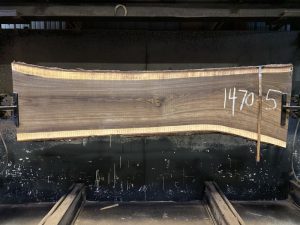
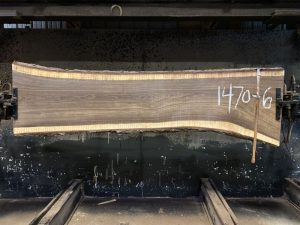
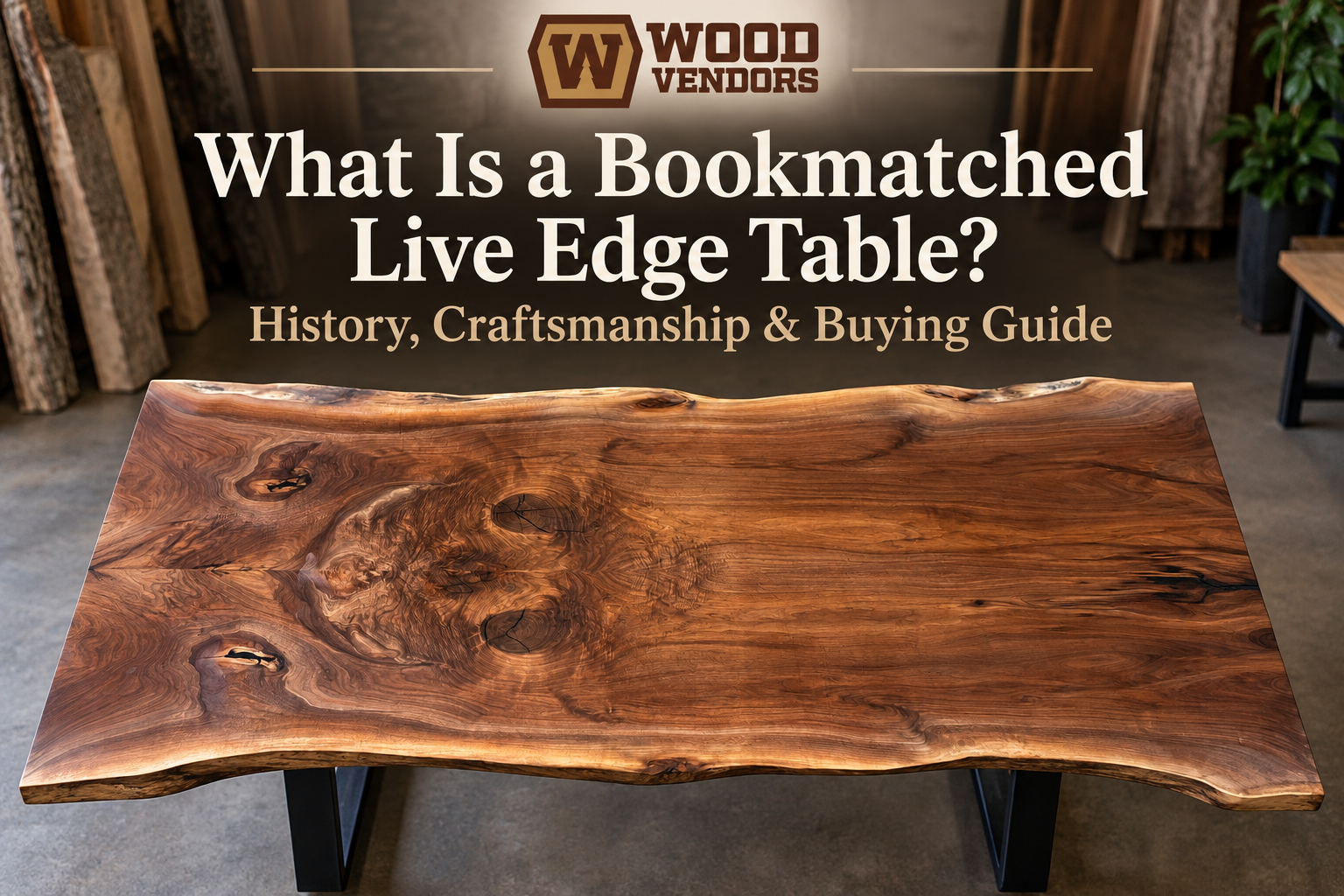
walnut slab 1470-5 walnut slab 1470-6walnut slab 1470-5&6 bookmatch simulation
These two slabs 1470-5,6 would be bookmatched to create the table above.

The History of Bookmatching
Although bookmatched slab tables have become a modern design staple, the technique of bookmatching has existed for centuries.
Long before live edge furniture became popular, fine furniture makers and cabinet shops used bookmatching on thin wood veneers to create decorative panels, cabinet doors, dining tables, and musical instruments. By opening two consecutive veneer sheets like the pages of a book, craftsmen could create perfectly symmetrical grain patterns that highlighted the natural beauty of the wood.
As sawmills became capable of milling larger hardwood logs into thick slabs, woodworkers realized the same technique could be applied to solid lumber. Instead of matching thin veneer leaves, they were matching entire slabs from the same tree.
What started as a decorative woodworking technique eventually evolved into one of the most recognizable styles in custom furniture.

The Rise of Live Edge Bookmatched Tables
The popularity of live edge furniture began to grow during the mid-20th century, thanks in large part to renowned woodworker George Nakashima.  Rather than hiding knots, bark, or irregular edges, Nakashima celebrated them. His philosophy was simple: every tree has its own story, and furniture should preserve that story rather than erase it.
While his work inspired generations of craftsmen, live edge furniture remained relatively niche for several decades.
That changed in the early 2000s. Television home renovation shows, social media, and custom furniture makers introduced millions of homeowners to the beauty of live edge tables. Designers began incorporating natural wood into modern interiors, blending organic materials with steel, glass, and concrete.
At the same time, advances in kiln drying, CNC flattening, epoxy stabilization, and shipping made it possible to build and transport larger custom slab tables than ever before.
Bookmatched tables became especially popular because they offered something a single slab often couldn’t—a dramatic centerpiece that could span six, eight, ten, or even twenty feet while maintaining the appearance of a single flowing piece of wood.
If you’re still deciding between a single slab and a bookmatched tabletop, our selection of live edge slabs can help you compare the possibilities for your project:
https://woodvendors.com/live-edge-slabs/
Today, they are among the most requested styles for custom furniture, prized for their balance of natural beauty, craftsmanship, and practicality.

Why Choose a Bookmatched Table Instead of a Single Slab?
Single slab tables are stunning, but they’re limited by the size of the tree they came from. Exceptionally wide logs are rare, and slabs over 40 to 50 inches wide become increasingly difficult—and expensive—to source.
Bookmatching solves that challenge.
By joining two consecutive slabs from the same log, craftsmen can create tabletops that are significantly wider while maintaining a nearly continuous grain pattern. This makes it possible to build expansive dining tables, conference tables, and kitchen islands without sacrificing the visual impact of natural wood.
Bookmatched tables also provide a sense of balance that many designers love. The mirrored grain creates symmetry without feeling artificial, making the tabletop itself the focal point of the room. Every knot, cathedral, curl, or color change appears to echo across the center seam, creating a look that simply can’t be recreated with random boards or unrelated slabs.
The species you choose also has a major impact on the finished appearance. Rich Walnut offers timeless elegance, White Oak delivers a clean modern look, Ash showcases bold grain, while Spalted Maple creates dramatic natural artwork unlike any other hardwood.
For many homeowners, it’s the best of both worlds—the impressive scale of a large custom table combined with the unique character of a single tree.

Did You Know?
Did you know? Every year a tree grows, it creates another growth ring. When you look at a bookmatched tabletop, you’re actually seeing decades—and sometimes more than a century—of the tree’s history mirrored across the center seam. Some of the largest bookmatched conference tables are built from slabs over 20 feet long, allowing the grain pattern to flow continuously across an entire room.
A contender for one of the largest true live-edge bookmatched tops has to be this 25-foot long x 5-foot wide table crafted by artisan Taylor Donsker which can be viewed here: A Live Edge Walnut Book Matched Conference Table —  Thanks to Taylor Donsker Design

Common Uses for Bookmatched Slabs
One of the biggest advantages of bookmatched slabs is their versatility. While they’re best known for dining tables, they are used in countless custom woodworking projects where both size and visual impact matter.
Some of the most common applications include:
  • Dining tables
  • Conference tables
  • Executive desks
  • Kitchen islands
  • Waterfall island countertops
  • Coffee tables
  • Reception desks
  • Restaurant tabletops
  • Bar tops
  • Retail display tables
  • Floating shelves
  • Bathroom vanities
  • Fireplace mantels
  • Custom countertops
Whether installed in a modern office, a mountain lodge, a luxury restaurant, or a family dining room, a bookmatched tabletop becomes more than just furniture—it becomes the centerpiece of the space.
Because every pair comes from a single tree, no two projects are ever exactly alike, making each table a one-of-a-kind piece that cannot be replicated.
If you’re ready to begin your own project, browse our inventory of live edge slabs or contact our team to find a bookmatched pair that fits your vision.
https://woodvendors.com/live-edge-slabs/

Continue Learning
If you enjoyed this guide, you may also like:
  • Best Wood Slabs for Outdoor Tables & Countertops
  • How to Choose the Right Walnut for Your Woodworking Project
  • Reclaimed Wood Beams: Why These Massive Timbers Can’t Be Replaced
Enquire Now

Have questions or need more information? Fill out the form below to enquire now and we’ll get back to you shortly.


    Call Now Enquire Now
    ×
    Enquire Now

    Have questions or need more information? Fill out the form below to enquire now and we’ll get back to you shortly.

      About Us
      footer logo

      We make finding quality wood easy.

      INFORMATION
      • Home
      • Slabs
      • Lumber
      • Dimension
      • Mouldings
      • Reclaimed
      • B.F. Calculator
      • Contact Us
      • Testimonials
      WoodVendors Office

      1-877-983-6367

      1-877-983-6367

      Mon - Fri: 8:00AM - 4:00PM

      Copyright © Wood Vendors, Inc. 2006 - All Rights Reserved
      MENU
      • Slabs
        • Featured
          • Walnut Slabs
          • White Oak Slabs
          • Large Live Edge Tabletop Slabs
          • Discount Slabs
          • *Latest Live Edge Slab Kiln Drop
          • River Table Slabs
        • Short Slabs and Rounds
        • Ambrosia Maple Slabs
        • Aromatic Red Cedar Slabs
        • Ash Slabs
        • Black Gum Slabs
        • Cherry Slabs
        • Curly Maple Slabs
        • Cypress Slabs
        • Elm Slabs
        • Hard Maple Slabs
        • Hickory Slabs Live Edge
        • Katalox Slabs
        • Kentucky Coffee Tree Slabs
        • Mango Slabs
        • Mappa Burl Slabs
        • Myrtlewood Slabs
        • Osage Orange Slabs
        • Padouk Slabs
        • Parota Slabs
        • Pecan Slabs
        • Poplar Slabs
        • Red Elm Slabs
        • Red Mulberry Slabs
        • Red Oak Slabs
        • Redwood Slabs and Burls
        • Sipo Mahogany Slabs
        • Soft Maple Slabs
        • Spalted Ash Slabs
        • Spalted Hackberry
        • Spalted Maple Slabs
        • Spalted Sycamore
        • Sycamore Slabs
        • White Pine Slabs
        • Bases
      • Lumber
        • Exotic Lumber for Sale
        • African Mahogany Lumber
        • Afrormosia Lumber
        • Alder Lumber
        • Aniegre Lumber
        • Aromatic Cedar Lumber
        • Ash Lumber
        • Avodire Lumber
        • Beli Lumber
        • Bloodwood Lumber
        • Bocote Lumber
        • Bosse Lumber
        • Bubinga Lumber
        • Butternut Lumber
        • Canarywood Lumber
        • Caribbean Rosewood
        • Cherry Lumber
        • Chestnut Lumber
        • Cocobolo Lumber
        • Cumaru Lumber
        • East Indian Rosewood
        • Edinam Lumber
        • Granadillo Lumber
        • Guatemala Rosewood
        • Hard Maple Lumber
        • Hickory Lumber
        • Honduras Rosewood
        • Ipe Lumber
        • Iroko Lumber
        • Jatoba Lumber
        • Koa Lumber
        • Leopardwood Lumber
        • Limba Lumber
        • Macassar Ebony
        • Mahogany Lumber
        • Makore Lumber
        • Marblewood Lumber
        • Morado Lumber
        • Myrtlewood Lumber
        • Nogal Lumber
        • Obeche Lumber
        • Padouk Lumber
        • PC Maple Lumber
        • Purpleheart Lumber
        • Red Elm Lumber
        • Red Grandis Lumber
        • Red Oak Lumber
        • Redheart Lumber
        • Santos Mahogany Lumber
        • Sapele Lumber
        • Shedua Lumber
        • Sipo Lumber
        • Soft Maple Lumber
        • Spanish Cedar Lumber
        • Teak Lumber
        • Walnut Lumber
        • Wenge Lumber
        • White Oak Lumber
        • Rift White Oak Lumber
        • Yellow Birch Lumber
        • Yellowheart Lumber
        • Zebrawood Lumber
        • Zebrawood, Red Ebiara
      • Mouldings-S4S
        • Dimension
          • African Mahogany Dimension
          • Alder, Knotty Dimension
          • Alder, Superior Dimension
          • Ash Dimension
          • Birch Dimension
          • Cherry Dimension
          • Douglas Fir Dimension
          • Hard Maple Dimension
          • Mahogany Dimension
          • Poplar Dimension
          • Red Grandis Dimension
          • Red Oak Dimension
          • Sapele, Flat Sawn Dimension
          • Sapele, Ribbon Dimension
          • Sipo Dimension
          • Soft Maple Dimension
          • Spanish Cedar Dimension
          • Teak Dimension
          • Walnut Dimension
          • Western Red Cedar Dimension
          • White Oak Dimension
          • White Oak, Quartersawn Dimension
        • Mouldings
          • Alder, Knotty Mouldings
          • Alder, Superior Mouldings
          • Cherry Mouldings
          • Maple Mouldings
          • Poplar Mouldings
          • Red Oak Mouldings
        • Knotty Alder Tongue & Groove
        • Box Beams
      • Reclaimed
        • Reclaimed Lumber
        • Reclaimed Solid Hardwood Beams
        • Reclaimed Wall Cladding
        • Reclaimed Flooring
      • Hot Deals
      • B.F. Calculator
      • Blog
      • Testimonials
      • Contact Us
      • Price Trending