
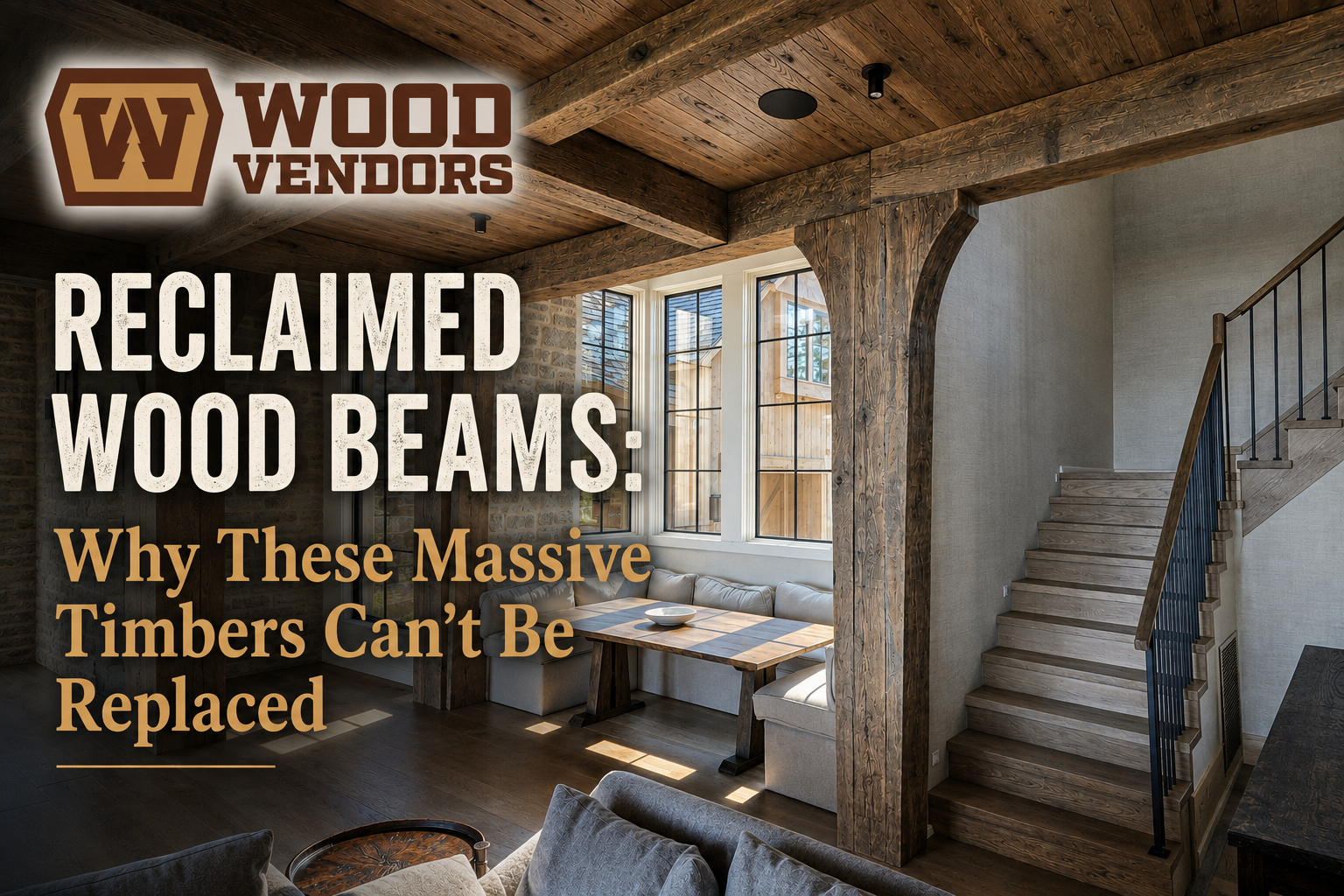
Walk into a century-old barn, church, or industrial building and look up. The massive wood beams overhead tell a story that modern lumber simply cannot replicate.
Many of the large reclaimed beams available today come from structures built 100 to 200 years ago, when old-growth forests provided enormous trees capable of producing exceptionally large timbers. These beams were often hand-hewn and crafted from slow-growing wood with tight grain patterns that are difficult to find in today’s lumber supply.
As these historic buildings reach the end of their service life, careful deconstruction allows these remarkable beams to be reclaimed and reused in new projects. Old churches, barns, mills, and warehouses have become valuable sources of architectural timber, preserving a piece of history while giving the wood a second life.
Why We Don’t See Beams This Large Anymore
The reality is simple: the trees used to create many of these historic beams are no longer readily available.
Much of America’s early construction relied on old-growth forests. Trees grew for centuries before being harvested, producing large diameters and dense grain structures. Today’s forestry practices focus on sustainable harvesting and second-growth timber, which produces excellent building materials but generally not the massive solid timbers commonly found in historic structures.
As a result, reclaimed beams have become highly sought after for custom homes, commercial buildings, restaurants, timber-frame structures, and architectural projects where authentic character and scale matter.
Why Reclaimed Beams Are So Valuable
Reclaimed wood beams are more than just building materials—they are pieces of American history.
Many reclaimed beams originate from barns, churches, factories, mills, warehouses, and agricultural structures built during the 1800s and early 1900s. These buildings were often constructed using large old-growth timbers harvested from forests that no longer exist in the same abundance today. As these historic structures are carefully deconstructed, the beams are salvaged, cleaned, and prepared for reuse in modern projects.
What makes reclaimed beams special is their character. Unlike newly milled lumber, reclaimed timbers feature natural weathering, hand-hewn surfaces, circular saw marks, mortise-and-tenon joinery, peg holes, and rich patina developed over decades or even centuries. Every beam tells a story, making each project truly unique.
Because the supply of reclaimed timber is limited to existing historic structures, these beams are becoming increasingly difficult to source. Once an old church, barn, or factory is demolished without salvage, that piece of history is gone forever. Careful deconstruction preserves these materials and allows them to be incorporated into new homes and commercial projects for generations to come.
Modern Uses for Reclaimed Beams
Today, reclaimed beams are used in a wide variety of residential and commercial applications.
In custom homes, reclaimed timbers are frequently incorporated as exposed ceiling beams, fireplace mantels, entryway accents, trusses, and structural elements. Designers often use reclaimed beams to create warmth and authenticity in spaces ranging from rustic farmhouses to modern luxury homes.
Commercial architects and builders use reclaimed beams to add character to restaurants, breweries, hotels, retail spaces, wineries, and office buildings. The aged appearance and historical significance of reclaimed wood help create memorable environments that cannot be replicated with newly manufactured materials.
Reclaimed timbers are also popular in timber-frame construction, where they serve as both structural and architectural features. Their size and strength make them ideal for projects that require substantial wood members while maintaining a timeless appearance.
Many homeowners choose reclaimed beams simply because there is no substitute for the look of a genuine century-old timber. The texture, checking, color variation, and craftsmanship found in historic beams cannot be duplicated by modern manufacturing processes.
Sustainability and Preservation
Reusing reclaimed beams is also an environmentally responsible choice.
Rather than allowing historic timbers to end up in landfills, deconstruction and reclamation preserve valuable materials and extend their useful life for generations. Repurposing existing wood reduces demand for newly harvested timber while preserving craftsmanship from a different era.
Many architects and homeowners choose reclaimed wood not only for its beauty but also because it contributes to sustainable building practices and adaptive reuse projects.
Reclaimed Beams vs. Box Beams
Not every project requires a full solid timber beam. While authentic reclaimed beams remain the preferred choice when original structural members and historic character are desired, many homeowners, builders, and designers choose box beams as a practical alternative.
Box beams are constructed from real wood and fabricated into a hollow beam that delivers the appearance of a massive timber while weighing significantly less than a solid beam. This makes them ideal for decorative ceiling applications, vaulted great rooms, kitchens, commercial spaces, and remodeling projects where the structure may not support the weight of large reclaimed timbers.
One advantage of box beams is flexibility. Designers can achieve the look of oversized rustic beams without the installation challenges that often come with solid wood timbers. When crafted using reclaimed wood, box beams can provide much of the same weathered texture, saw marks, hand-hewn character, and aged patina that make reclaimed beams so desirable.
At Wood Vendors, we offer both authentic reclaimed beams salvaged from historic barns, churches, factories, and warehouses, as well as custom-crafted box beams that deliver the same timeless appearance in a lightweight format.
Learn more about our:
-
Reclaimed Beams: https://woodvendors.com/reclaimed-beams/
-
Box Beams: https://woodvendors.com/box-beams/
The Rise of Glulam Beams
When modern construction requires long spans and large structural members, engineers typically turn to glue-laminated timber, commonly known as glulam.
Glulam beams are manufactured by bonding multiple layers of dimensional lumber together under pressure to create large structural members. This engineered process allows builders to achieve spans and sizes that would be difficult or impossible using solid-sawn lumber alone.
Because the enormous old-growth trees that once supplied massive timbers are no longer readily available, glulam has become the modern solution for large-scale construction. Today’s schools, airports, sports facilities, churches, and commercial buildings frequently rely on glulam beams to achieve open spaces and long structural spans.
While glulam provides tremendous engineering advantages, many architects and designers still seek reclaimed beams when they want the authentic appearance, history, and character that only aged timber can provide.
Portland International Airport: A Modern Timber Showcase
One of the most impressive examples of modern timber construction can be found at Portland International Airport (PDX).
The airport’s recently completed expansion features one of the largest mass timber roof structures in North America. The project incorporates millions of board feet of Douglas Fir and extensive use of glulam beams to create sweeping open spaces that celebrate the Pacific Northwest’s timber heritage.
The structure demonstrates how engineered wood products can achieve architectural scale that once required enormous old-growth timbers. Some of the glulam beams span impressive distances while creating the warm, natural aesthetic that wood construction is known for.
Projects like Portland International Airport highlight how the industry has evolved—from harvesting massive old-growth trees for solid timbers to engineering high-performance glulam beams capable of supporting today’s most ambitious designs.
Preserving History Through Reclaimed Timber
While engineered wood products continue to transform modern construction, reclaimed beams remain irreplaceable.
Each beam carries evidence of its past life—hand-hewn surfaces, mortise-and-tenon joinery, weathered patina, saw marks, and craftsmanship that may date back more than a century. When reclaimed from historic churches, barns, mills, and industrial buildings, these timbers preserve a piece of American history while serving a new purpose.
Whether incorporated into a timber-frame home, a luxury commercial space, a restaurant, or a custom residential project, reclaimed beams bring authenticity that modern manufacturing simply cannot reproduce.
Bring Historic Timber Into Your Next Project
Looking for authentic reclaimed wood beams or custom box beams?
Wood Vendors specializes in sourcing and supplying reclaimed timbers from historic barns, churches, factories, and industrial buildings throughout North America. We also craft custom box beams that capture the appearance of massive old-growth timbers while providing greater installation flexibility.
Whether your project calls for a structural reclaimed beam or a decorative box beam, our team can help you find the right solution to bring timeless character and craftsmanship into your space.
Explore our collections:
-
Reclaimed Beams: https://woodvendors.com/reclaimed-beams/
-
Box Beams: https://woodvendors.com/box-beams/