
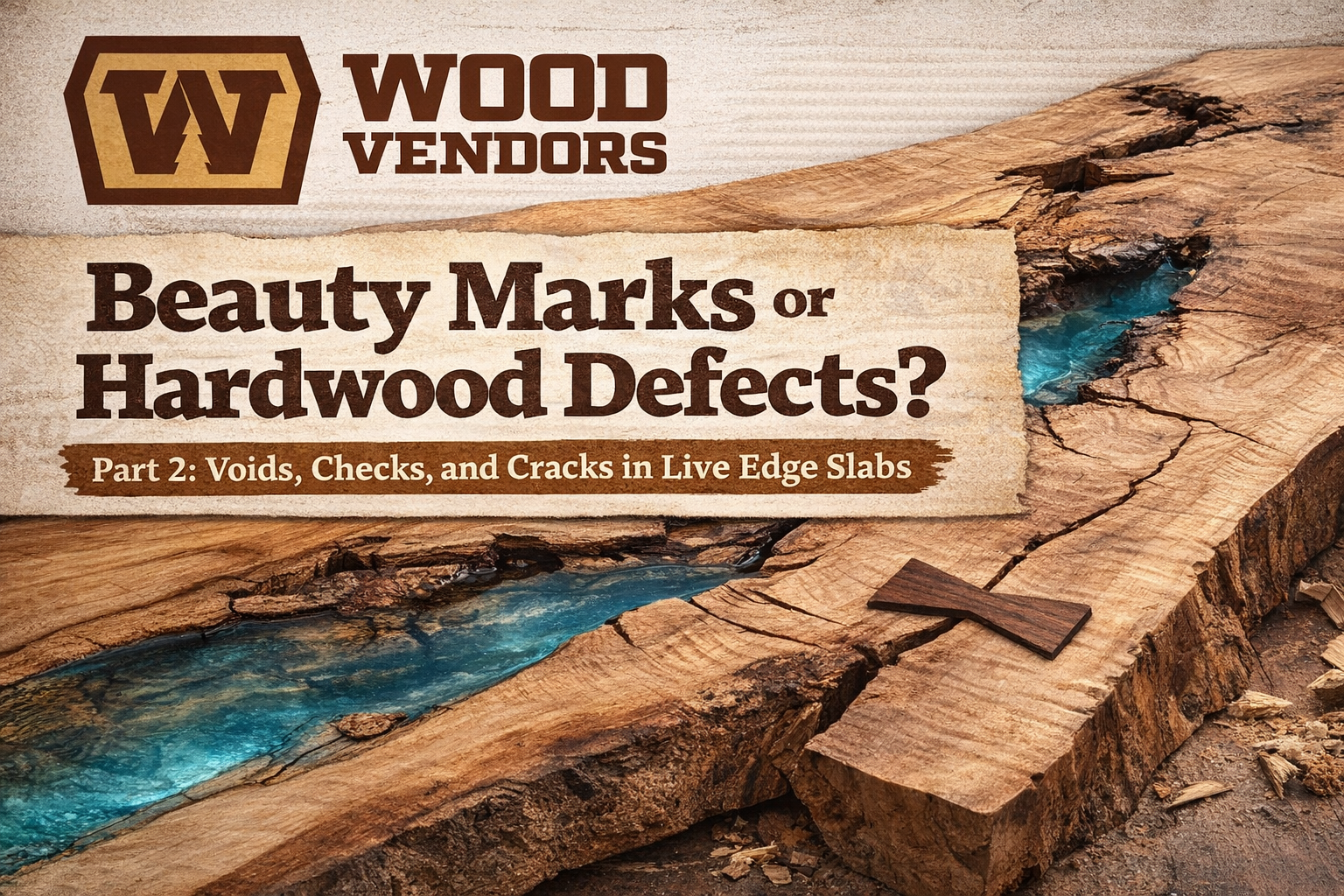
In Part 1, we explored one of the most surprising slab “defects” — hidden metal. Now, let’s move into something far more common, and far more debated:
Voids, checks, and cracks.
Depending on who you ask, these are either flaws to avoid… or the very reason a slab becomes unforgettable.
What Are Voids, Checks, and Cracks?
Before we decide whether they’re defects or design features, let’s define them:
- Voids – Open cavities in the wood, often caused by knots falling out, decay, or natural growth irregularities
- Checks – Small cracks that run along the grain, typically formed during drying
- Cracks / Splits – Larger separations that may run deeper or even through the slab
All three interrupt the “clear wood” surface — which is exactly why traditional lumber grading considers them defects.
In fact, a defect is technically anything that reduces the amount of usable, sound wood in a board.
👉 “Learn more about how lumber is graded with the NHLA”
Why Do They Happen?
Here’s the key truth: these features are not mistakes — they’re natural processes.
1. Moisture Loss and Drying Stress
Wood is full of moisture when it’s freshly cut. As it dries:
- The outer layers shrink faster than the inner core
- This creates internal tension
- When the stress exceeds the wood’s strength, it cracks
This is how checks and cracks form — a direct result of uneven drying and shrinkage.
It’s also why cracks almost always follow the grain and often appear at the ends of slabs.
2. Tree Growth and Natural Weak Points
Voids often originate long before the tree is cut:
- Branches die and fall out → leaving holes
- Bark gets trapped inside the tree → later becomes pockets
- Internal decay creates soft or missing wood
These become the dramatic voids and openings that live edge slabs are known for.
3. Environmental Movement Over Time
Even after milling, wood continues to move:
- Changes in humidity cause expansion and contraction
- Repeated cycles can widen checks into cracks
- Larger splits can develop if stresses continue
Small checks may be harmless, but larger cracks can signal deeper movement or instability.
👉 “how to care for live edge slabs”
Why They’re Considered “Defects”
In traditional hardwood grading (NHLA), the goal is simple:
👉 Maximize clear, usable cutting area
Voids, checks, and cracks:
- Reduce yield
- Interrupt clean cuts
- Can affect structural integrity (especially large splits)
So in a grading sense, they’re clearly defects.
But slabs aren’t graded like dimensional lumber.
And that changes everything.
When Defects Become Beauty
Live edge slabs flipped the script.
Instead of cutting around imperfections, we celebrate them.
Why People Love Them
- Authenticity – You can literally see the life of the tree
- Uniqueness – No two slabs are alike
- Organic design – Nature creates patterns no machine can replicate
- Contrast – Voids and cracks add visual tension against smooth surfaces
Even checks — once considered undesirable — are now appreciated for the character they bring. In many cases, they don’t even impact structural performance but add rustic appeal.
Why Some People Don’t
Not everyone is on board — and that’s fair.
Common concerns:
- “It looks unfinished”
- “Will it keep cracking?”
- “Is it structurally sound?”
- “It doesn’t fit a modern aesthetic”
For clean, minimalist designs, these features can feel like distractions rather than enhancements.
Turning Imperfections Into Design Features
This is where craftsmanship meets creativity.
Voids and cracks aren’t just accepted — they’re often the centerpiece.
1. Epoxy Resin Fills
The most popular approach:
- Fill voids with clear or colored epoxy
- Create “river tables” or highlight natural openings
- Add pigments, metallics, or even glow effects
👉 The void becomes a design element instead of a flaw.
2. Butterfly (Dutchman) Keys
A timeless woodworking technique:
- Inlaid across cracks
- Prevent further splitting
- Adds a handcrafted, artisan look
These transform structural concerns into visual highlights.
3. Leaving Them Natural
Sometimes, less is more:
- Open voids for a raw, organic feel
- Cracks left untouched for authenticity
- Ideal for rustic or statement pieces
4. Backfilling and Stabilization
For functionality:
- Use wood patches or fillers
- Reinforce from beneath
- Maintain usability without losing character
The Real Question: Defect or Feature?
Here’s the honest answer:
👉 It depends on your goal.
- If you’re grading lumber → they’re defects
- If you’re designing a slab → they’re opportunities
Live edge design lives in that tension — between control and nature.
Final Thoughts
Voids, checks, and cracks tell a story:
- How the tree grew
- How it dried
- How it moved over time
They are the fingerprints of nature.
And in the world of live edge slabs, those fingerprints often matter more than perfection.
👉 Order your custom table now!
Up next in Part 3: We’ll explore spalting, mineral streaks, and color variations — defects that might be the most beautiful of all.