
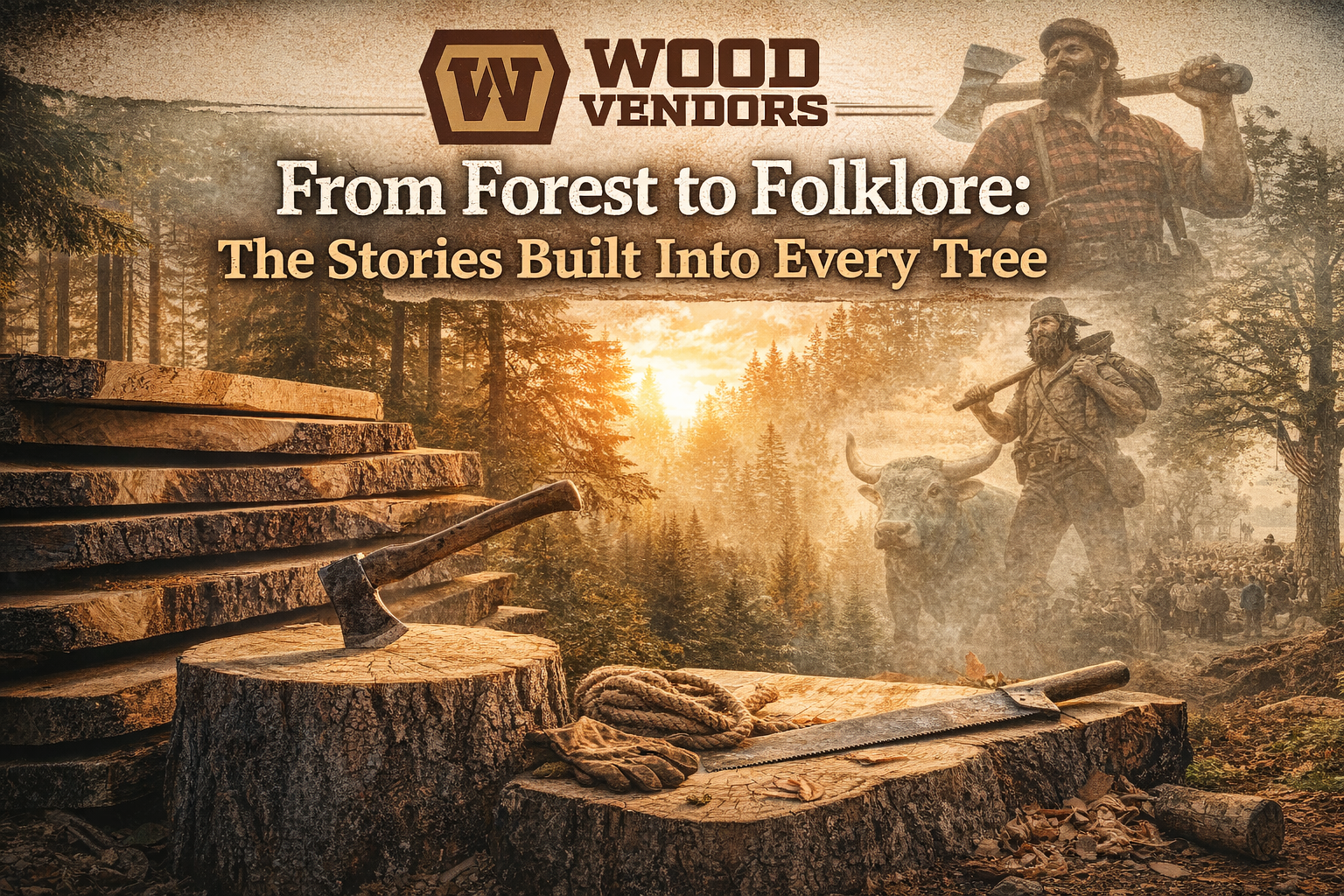
At Wood Vendors, everything starts with a tree.
Not just the material—but the history, the character, the story that’s been growing for decades (sometimes centuries) before it ever hits a mill. Long before custom tables, live edge slabs, or statement pieces, trees played a central role in how Americans understood the land—and themselves.
And if you look back at American fables, that connection runs deep.
The Original “Seed to Slab” Story
Take Johnny Appleseed.
His story gets told like a legend—walking barefoot across the frontier, planting apple trees wherever he went. The reality was more strategic, but the meaning stuck. Planting trees wasn’t just about food—it was about building something that outlives you.
That idea still hits.
We see it every time a slab gets turned into a table that’ll be around for generations. Different scale, same mindset: start with something natural, create something lasting.
Bigger Than Life
Then you’ve got Paul Bunyan—the guy who supposedly cleared entire forests with a single swing.
Obviously exaggerated. But it came from somewhere real.
Those stories came out of logging camps—guys working long days in massive forests, turning raw timber into the backbone of growing cities. The scale of the work felt unreal, so the stories became unreal too.
And honestly, if you’ve ever stood next to a massive slab, you get it. Trees can feel larger than life.
Built From One Tree
A better one—something that actually ties directly into how wood gets used—is the story of the Liberty Tree.
Back in the days leading up to the American Revolution, this wasn’t just any tree. It became a gathering point in Boston where colonists rallied, protested, and pushed back against British rule. It stood for independence, unity, and the idea that something rooted in the ground could still spark massive change.
Eventually, the British cut it down.
But that didn’t kill what it stood for—it amplified it. The “Liberty Tree” became a symbol across the colonies. People started naming other trees after it. The idea spread.
That’s the kind of story that sticks.
One tree—real impact.
The Real Connection
Here’s the thing—these stories weren’t just entertainment.
They reflected how people saw trees:
- Not just resources, but opportunity
- Not just wood, but something to build a future with
- Not just part of the land, but part of their identity
That same connection still exists. It’s just evolved.
Today, it’s less about clearing forests—and more about respecting the material. Using it right. Letting the natural edges, grain, and imperfections speak for themselves.
Why It Still Matters
Every slab we source has its own story.
Growth rings that mark time. Grain patterns shaped by environment. Natural edges that were never meant to be perfectly straight—and that’s exactly the point.
That’s what makes custom wood different. You’re not buying something mass-produced. You’re working with a piece of nature that already had a life before it ever became furniture.
The old fables just put words to something we still believe:
Trees aren’t just materials—they’re legacy.
Bringing It Full Circle
From Johnny Appleseed planting roots, to Paul Bunyan shaping landscapes, to the legacy of the Liberty Tree—there’s a straight line connecting it all.
Same raw material. Different chapter.
At Wood Vendors, we’re just continuing the story—taking what nature built and turning it into something that’ll last.
One slab at a time.