
• Price Trending B.F. Calculator Testimonials
  • 1-877-983-6367
Logo
  • Slabs
    • Discount Slabs
    • *Latest Live Edge Slab Kiln Drop
    • Large Live Edge Tabletop Slabs
    • River Table Slabs
    • Short Slabs and Rounds
    • Ambrosia Maple Slabs
    • Aromatic Red Cedar Slabs
    • Ash Slabs
    • Black Gum Slabs
    • Cherry Slabs
    • Curly Maple Slabs
    • Cypress Slabs
    • Elm Slabs
    • Hard Maple Slabs
    • Hickory Slabs Live Edge
    • Katalox Slabs
    • Kentucky Coffee Tree Slabs
    • Mango Slabs
    • Mappa Burl Slabs
    • Myrtlewood Slabs
    • Osage Orange Slabs
    • Padouk Slabs
    • Parota Slabs
    • Pecan Slabs
    • Red Elm Slabs
    • Red Mulberry Slabs
    • Red Oak Slabs
    • Redwood Slabs and Burls
    • Sipo Mahogany Slabs
    • Soft Maple Slabs
    • Spalted Maple Slabs
    • Spalted Sycamore
    • Sycamore Slabs
    • Walnut Slabs
    • White Oak Slabs
    • White Pine Slabs
    • Tables, Tops, and Bases
  • Lumber
    • Exotic Lumber for Sale
    • African Mahogany Lumber
    • Afrormosia Lumber
    • Alder Lumber
    • Aniegre Lumber
    • Aromatic Cedar Lumber
    • Ash Lumber
    • Avodire Lumber
    • Beli Lumber
    • Bloodwood Lumber
    • Bocote Lumber
    • Bosse Lumber
    • Bubinga Lumber
    • Butternut Lumber
    • Canarywood Lumber
    • Caribbean Rosewood
    • Cherry Lumber
    • Chestnut Lumber
    • Cocobolo Lumber
    • Cumaru Lumber
    • East Indian Rosewood
    • Edinam Lumber
    • Granadillo Lumber
    • Guatemala Rosewood
    • Hard Maple Lumber
    • Hickory Lumber
    • Honduras Rosewood
    • Ipe Lumber
    • Iroko Lumber
    • Jatoba Lumber
    • Koa Lumber
    • Leopardwood Lumber
    • Limba Lumber
    • Macassar Ebony
    • Mahogany Lumber
    • Makore Lumber
    • Marblewood Lumber
    • Morado Lumber
    • Myrtlewood Lumber
    • Nogal Lumber
    • Obeche Lumber
    • Padouk Lumber
    • PC Maple Lumber
    • Purpleheart Lumber
    • Red Elm Lumber
    • Red Grandis Lumber
    • Red Oak Lumber
    • Redheart Lumber
    • Santos Mahogany Lumber
    • Sapele Lumber
    • Shedua Lumber
    • Sipo Lumber
    • Soft Maple Lumber
    • Spanish Cedar Lumber
    • Teak Lumber
    • Walnut Lumber
    • Wenge Lumber
    • White Oak Lumber
    • Rift White Oak Lumber
    • Yellow Birch Lumber
    • Yellowheart Lumber
    • Zebrawood Lumber
    • Zebrawood, Red Ebiara
  • Mouldings-S4S
    • Dimension
      • African Mahogany Dimension
      • Alder, Knotty Dimension
      • Alder, Superior Dimension
      • Ash Dimension
      • Birch Dimension
      • Cherry Dimension
      • Douglas Fir Dimension
      • Hard Maple Dimension
      • Mahogany Dimension
      • Poplar Dimension
      • Red Grandis Dimension
      • Red Oak Dimension
      • Sapele, Flat Sawn Dimension
      • Sapele, Ribbon Dimension
      • Sipo Dimension
      • Soft Maple Dimension
      • Spanish Cedar Dimension
      • Teak Dimension
      • Walnut Dimension
      • Western Red Cedar Dimension
      • White Oak Dimension
      • White Oak, Quartersawn Dimension
    • Mouldings
      • Alder, Knotty Mouldings
      • Alder, Superior Mouldings
      • Cherry Mouldings
      • Maple Mouldings
      • Poplar Mouldings
      • Red Oak Mouldings
    • Knotty Alder Tongue & Groove
    • Box Beams
  • Reclaimed
    • Reclaimed Lumber
    • Reclaimed Solid Hardwood Beams
    • Reclaimed Wall Cladding
    • Reclaimed Flooring
  • Hot Deals
  • B.F. Calculator
  • Blog
  • Testimonials
  • Contact Us
  • Price Trending

Understanding NHLA Rules and Global Hardwood Standards

NHLA Blog
Posted on May 2, 2026

In the hardwood lumber industry, consistency and trust are everything. Buyers and sellers across regions, species, and applications need a common language to describe quality—and that’s where NHLA rules come in.

A Brief History of NHLA Grading

The National Hardwood Lumber Association (NHLA) was established in 1898 in Chicago at a time when the U.S. hardwood industry was rapidly expanding—but lacked standardization. Lumber quality varied widely between mills, leading to confusion, disputes, and inefficiencies in trade.

To solve this, NHLA developed a uniform grading system based on measurable yield rather than subjective appearance. By the early 1900s, these rules became widely adopted across the United States, helping create a more reliable and scalable hardwood market.

Over time, the rules have been refined and updated, but the core concept remains the same: grading lumber based on the amount of usable clear wood it can produce.

What Are NHLA Rules?

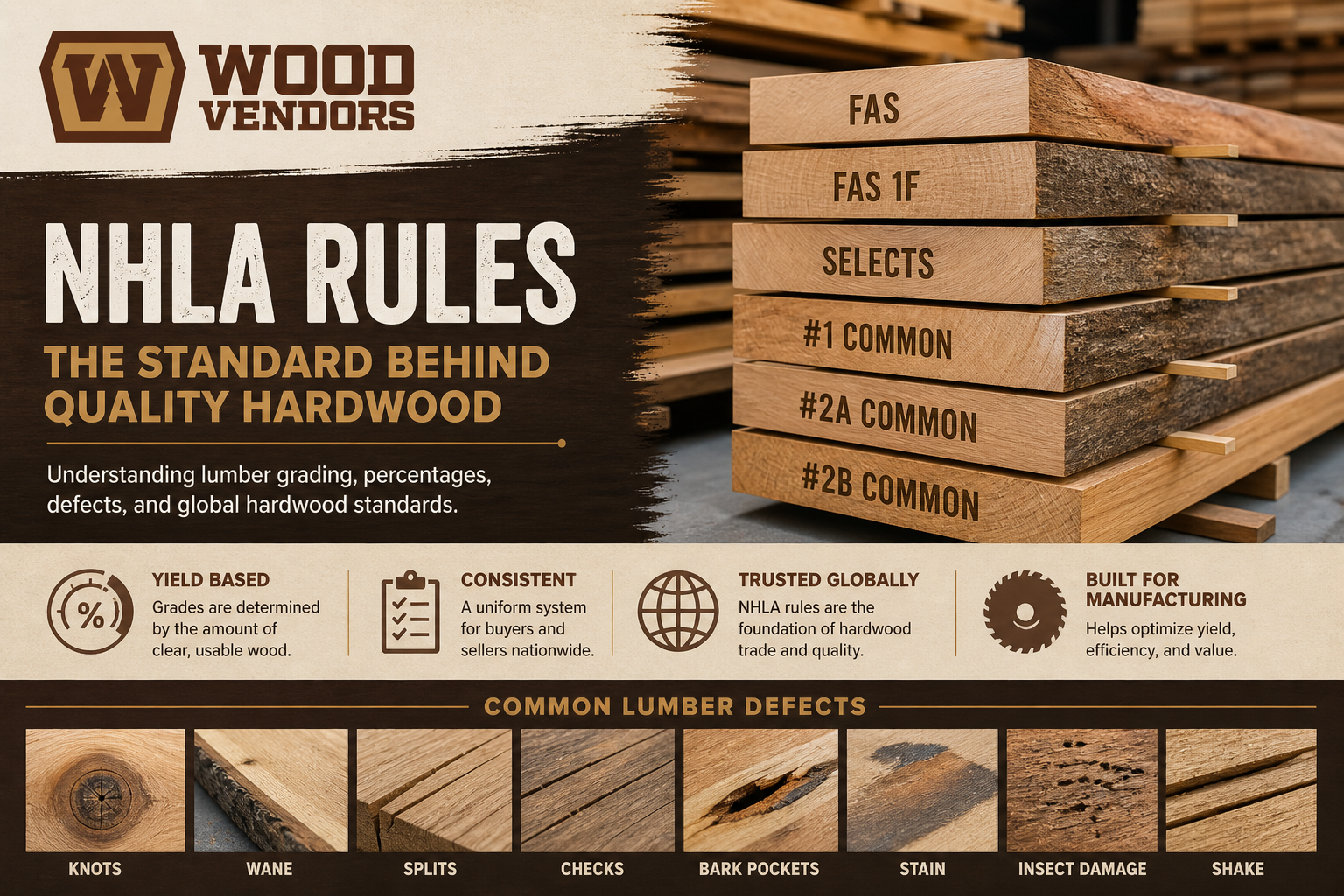
NHLA grading rules classify hardwood lumber based on the amount of usable, “clear” wood that can be cut from a board.

Rather than focusing only on appearance, NHLA grading is centered on yield—how much defect-free material a board can produce.

A Closer Look at Lumber Grading

NHLA grading evaluates several key factors:

  • Board size (length and width)
  • Cuttings (clear sections)
  • Defects
  • Yield percentage

A board doesn’t need to be visually perfect—it simply needs to provide enough usable material to meet a grade requirement.

NHLA Grades, Percentages, and Key Differences

  • FAS (First and Seconds)
    • Yield: Minimum 83 1/3% (10/12) clear wood
    • Large, wide cuttings
    • Best for high-end applications
  • FAS One Face (F1F)
    • One face FAS (83 1/3%), reverse #1 Common (66 2/3%)
    • Ideal when one face is visible
  • Selects
    • 83 1/3% yield on better face
    • Narrower boards than FAS
  • #1 Common
    • 66 2/3% (8/12) yield
    • Balanced quality and value
  • #2 Common (2A Common)
    • 50% (6/12) yield
    • More defects, smaller cuttings
  • #2B Common
    • Similar to #2A but allows more stain and color variation

Why These Differences Matter

  • Higher grades = less waste, higher cost, larger parts
  • Lower grades = more cutting, lower cost, smaller parts

Choosing the right grade directly impacts manufacturing efficiency and overall cost.

Common Lumber Defects in NHLA Grading

Understanding defects is key to understanding how lumber is graded—and it opens the door for deeper topics in future discussions.

Some of the most common defects include:

  • Knots – Areas where branches grew; can be sound or unsound
  • Wane – Missing wood or bark along the edge or corner
  • Splits – Cracks that extend through the thickness of the board
  • Checks – Surface cracks, usually from drying
  • Shake – Separation between growth rings

Additional defects often considered in grading:

  • Warp – Includes bow, cup, twist, or crook affecting board shape
  • Bark pockets – Small areas where bark is enclosed in the wood
  • Pitch pockets – Resin-filled voids common in some species
  • Stain – Discoloration from minerals, fungus, or improper drying
  • Insect damage – Holes or tunnels from insects
  • Pith – The soft center of the tree, often unstable
  • Decay/rot – Deterioration caused by fungi
  • Machine damage – Marks or gouges from milling equipment

Each of these defects affects yield differently, which is why NHLA grading focuses on how much clear wood can be recovered rather than simply counting imperfections.

Why NHLA Rules Are Followed

NHLA rules are widely followed because they create a standardized system:

  • Consistent grading across mills
  • Clear expectations for buyers
  • Improved manufacturing efficiency
  • Easier global trade

Hardwood Grading Outside the U.S.

Other regions use different systems:

  • Europe: Focuses more on structural strength classes
  • Canada: Aligns with NHLA for hardwoods, different for softwoods
  • Global markets: Often reference NHLA for U.S. hardwood imports

What NHLA Rules Don’t Cover

NHLA grading applies to standard hardwood lumber, not:

  • Live edge slabs
  • Thick specialty cuts
  • Reclaimed lumber
  • Custom pieces

Slabs are graded more on appearance, size, and character rather than yield, making them more subjective.

Final Thoughts

From its origins in the late 1800s to today’s global market, NHLA grading continues to provide a reliable framework for evaluating hardwood lumber.

Understanding grades, yields, and defects not only helps buyers make better decisions but also creates opportunities to dive deeper into specific topics—especially when it comes to the natural characteristics that make each board unique.

Enquire Now

Have questions or need more information? Fill out the form below to enquire now and we’ll get back to you shortly.


    Call Now Enquire Now
    ×
    Enquire Now

    Have questions or need more information? Fill out the form below to enquire now and we’ll get back to you shortly.

      About Us
      footer logo

      We make finding quality wood easy.

      INFORMATION
      • Home
      • Slabs
      • Lumber
      • Dimension
      • Mouldings
      • Reclaimed
      • B.F. Calculator
      • Contact Us
      • Testimonials
      WoodVendors Office

      1-877-983-6367

      1-877-983-6367

      Mon - Fri: 8:00AM - 4:00PM

      Copyright © Wood Vendors, Inc. 2006 - All Rights Reserved
      MENU
      • Slabs
        • Discount Slabs
        • *Latest Live Edge Slab Kiln Drop
        • Large Live Edge Tabletop Slabs
        • River Table Slabs
        • Short Slabs and Rounds
        • Ambrosia Maple Slabs
        • Aromatic Red Cedar Slabs
        • Ash Slabs
        • Black Gum Slabs
        • Cherry Slabs
        • Curly Maple Slabs
        • Cypress Slabs
        • Elm Slabs
        • Hard Maple Slabs
        • Hickory Slabs Live Edge
        • Katalox Slabs
        • Kentucky Coffee Tree Slabs
        • Mango Slabs
        • Mappa Burl Slabs
        • Myrtlewood Slabs
        • Osage Orange Slabs
        • Padouk Slabs
        • Parota Slabs
        • Pecan Slabs
        • Red Elm Slabs
        • Red Mulberry Slabs
        • Red Oak Slabs
        • Redwood Slabs and Burls
        • Sipo Mahogany Slabs
        • Soft Maple Slabs
        • Spalted Maple Slabs
        • Spalted Sycamore
        • Sycamore Slabs
        • Walnut Slabs
        • White Oak Slabs
        • White Pine Slabs
        • Tables, Tops, and Bases
      • Lumber
        • Exotic Lumber for Sale
        • African Mahogany Lumber
        • Afrormosia Lumber
        • Alder Lumber
        • Aniegre Lumber
        • Aromatic Cedar Lumber
        • Ash Lumber
        • Avodire Lumber
        • Beli Lumber
        • Bloodwood Lumber
        • Bocote Lumber
        • Bosse Lumber
        • Bubinga Lumber
        • Butternut Lumber
        • Canarywood Lumber
        • Caribbean Rosewood
        • Cherry Lumber
        • Chestnut Lumber
        • Cocobolo Lumber
        • Cumaru Lumber
        • East Indian Rosewood
        • Edinam Lumber
        • Granadillo Lumber
        • Guatemala Rosewood
        • Hard Maple Lumber
        • Hickory Lumber
        • Honduras Rosewood
        • Ipe Lumber
        • Iroko Lumber
        • Jatoba Lumber
        • Koa Lumber
        • Leopardwood Lumber
        • Limba Lumber
        • Macassar Ebony
        • Mahogany Lumber
        • Makore Lumber
        • Marblewood Lumber
        • Morado Lumber
        • Myrtlewood Lumber
        • Nogal Lumber
        • Obeche Lumber
        • Padouk Lumber
        • PC Maple Lumber
        • Purpleheart Lumber
        • Red Elm Lumber
        • Red Grandis Lumber
        • Red Oak Lumber
        • Redheart Lumber
        • Santos Mahogany Lumber
        • Sapele Lumber
        • Shedua Lumber
        • Sipo Lumber
        • Soft Maple Lumber
        • Spanish Cedar Lumber
        • Teak Lumber
        • Walnut Lumber
        • Wenge Lumber
        • White Oak Lumber
        • Rift White Oak Lumber
        • Yellow Birch Lumber
        • Yellowheart Lumber
        • Zebrawood Lumber
        • Zebrawood, Red Ebiara
      • Mouldings-S4S
        • Dimension
          • African Mahogany Dimension
          • Alder, Knotty Dimension
          • Alder, Superior Dimension
          • Ash Dimension
          • Birch Dimension
          • Cherry Dimension
          • Douglas Fir Dimension
          • Hard Maple Dimension
          • Mahogany Dimension
          • Poplar Dimension
          • Red Grandis Dimension
          • Red Oak Dimension
          • Sapele, Flat Sawn Dimension
          • Sapele, Ribbon Dimension
          • Sipo Dimension
          • Soft Maple Dimension
          • Spanish Cedar Dimension
          • Teak Dimension
          • Walnut Dimension
          • Western Red Cedar Dimension
          • White Oak Dimension
          • White Oak, Quartersawn Dimension
        • Mouldings
          • Alder, Knotty Mouldings
          • Alder, Superior Mouldings
          • Cherry Mouldings
          • Maple Mouldings
          • Poplar Mouldings
          • Red Oak Mouldings
        • Knotty Alder Tongue & Groove
        • Box Beams
      • Reclaimed
        • Reclaimed Lumber
        • Reclaimed Solid Hardwood Beams
        • Reclaimed Wall Cladding
        • Reclaimed Flooring
      • Hot Deals
      • B.F. Calculator
      • Blog
      • Testimonials
      • Contact Us
      • Price Trending