
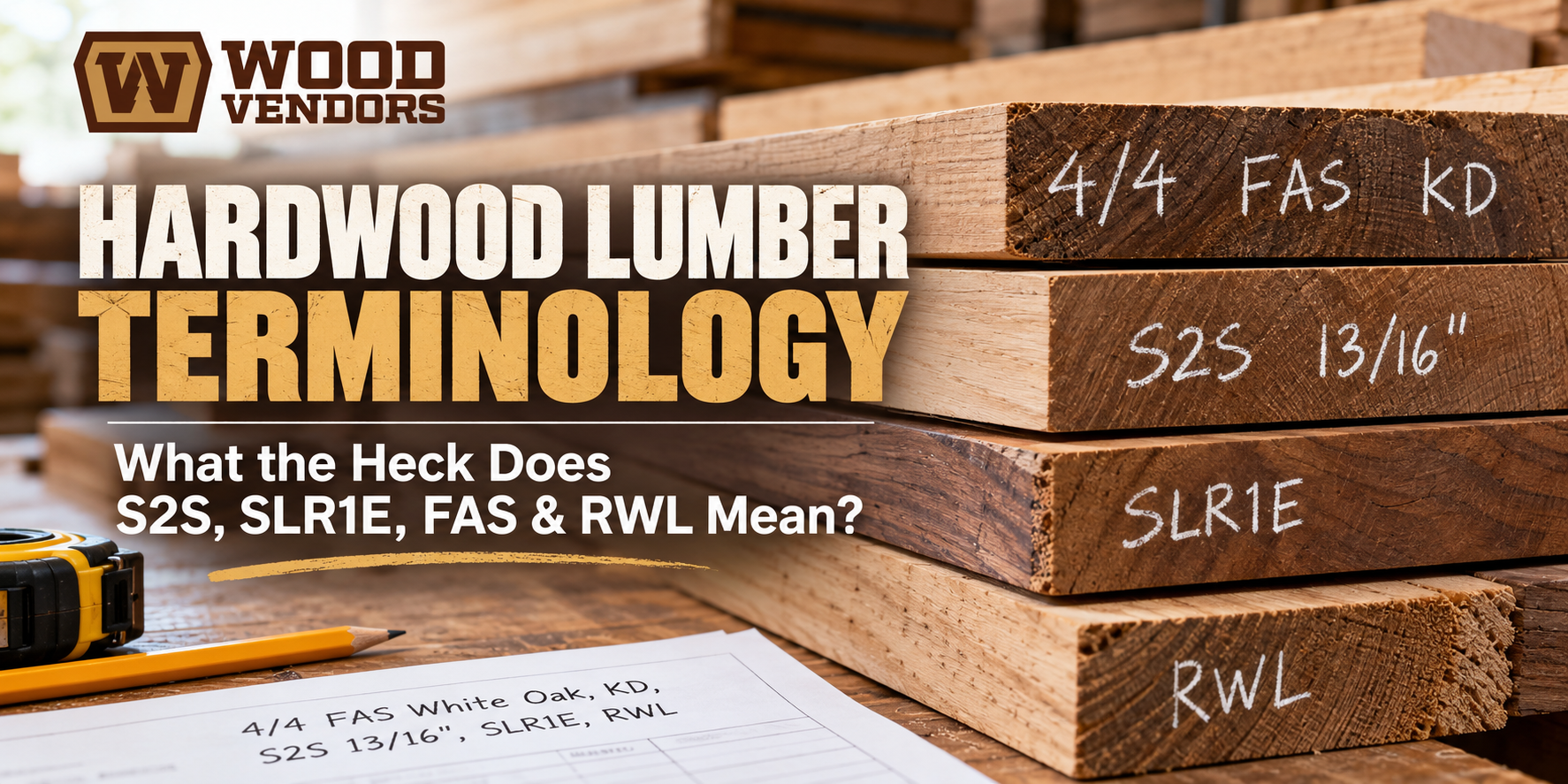
If you’ve ever received a hardwood lumber quote that reads something like:
4/4 FAS White Oak, KD, S2S 13/16″, SLR1E, RWL
…you may have wondered whether you ordered lumber or accidentally signed up for a chemistry class.
Don’t worry. Hardwood industry people have been speaking this strange little language for a long time.
Fortunately, once you know a handful of terms, it’s pretty simple.
Surfacing & Milling
RGH — Rough
Lumber that hasn’t been surfaced. Expect saw marks, some thickness variation and rough edges. Great if you have the equipment to mill it yourself or if you want to resaw it.
Lumber that hasn’t been surfaced. Expect saw marks, some thickness variation and rough edges. Great if you have the equipment to mill it yourself or if you want to resaw it.
S2S — Surfaced Two Sides
Both faces are surfaced to provide a more consistent thickness, while the edges generally remain rough.
Both faces are surfaced to provide a more consistent thickness, while the edges generally remain rough.
This is one of the most common ways we sell hardwood lumber.
S2S Hit & Miss
Both faces get a light surfacing, but some rough areas remain. It lets you see the grain and color and is ready to run through a moulder.
Both faces get a light surfacing, but some rough areas remain. It lets you see the grain and color and is ready to run through a moulder.
S3S — Surfaced Three Sides
Two faces and one edge are surfaced/straight line ripped.
Two faces and one edge are surfaced/straight line ripped.
S4S — Surfaced Four Sides
Both faces and both edges are surfaced. The lumber is much closer to its finished dimensions and ready for use. This is typically sold/measure per Linear Foot instead of by the board foot.
Both faces and both edges are surfaced. The lumber is much closer to its finished dimensions and ready for use. This is typically sold/measure per Linear Foot instead of by the board foot.
Straight-Line Ripping
SLR / SLR1E — Straight-Line Ripped One Edge
One edge is ripped straight, giving you a clean reference edge for additional processing.
One edge is ripped straight, giving you a clean reference edge for additional processing.
SLR2E — Straight-Line Ripped Two Edges
Both edges are straight. Widths can still vary unless you’ve ordered a specific finished width.
Both edges are straight. Widths can still vary unless you’ve ordered a specific finished width.
Cutting Lumber to Size
Chop / CTL — Chop or Cut to Length
The lumber is crosscut into specified lengths.
The lumber is crosscut into specified lengths.
For example:
S2S, SLR1E, chopped to 36″, 48″ and 60″
Rip to Width
The lumber is ripped to a specified width rather than supplied in random widths.
The lumber is ripped to a specified width rather than supplied in random widths.
Blank / Dimension Stock
Lumber that has already been processed closer to the dimensions required for manufacturing.
Lumber that has already been processed closer to the dimensions required for manufacturing.
This remove the risk of determining your yield.
Hardwood Lumber Grades
Most North American hardwood lumber is graded using NHLA (National Hardwood Lumber Association) rules.
One important thing to understand: hardwood grades generally aren’t beauty contests. They’re largely based on the amount and size of clear, usable cuttings obtainable from a board.
FAS — Firsts and Seconds
The highest standard NHLA grade for most hardwood species, providing a high percentage of clear wood in relatively large cuttings. Typically, 83 1/3% and better clear cuttings.
The highest standard NHLA grade for most hardwood species, providing a high percentage of clear wood in relatively large cuttings. Typically, 83 1/3% and better clear cuttings.
F1F — FAS One Face
One face meets FAS requirements while the reverse meets the applicable lower-grade requirements.
One face meets FAS requirements while the reverse meets the applicable lower-grade requirements.
SEL — Selects
Similar to F1F, but permits smaller minimum board sizes.
Similar to F1F, but permits smaller minimum board sizes.
No. 1 Common
Less clear yield than FAS, but often an excellent value when smaller clear pieces work for the project. Clear cuttings are typically 66 2/3%-83 1/3% clear cuttings
Less clear yield than FAS, but often an excellent value when smaller clear pieces work for the project. Clear cuttings are typically 66 2/3%-83 1/3% clear cuttings
No. 2A Common
Lower clear-cutting yield again, but useful when smaller components are needed. Typically 50%-66 2/3% clear cuttings.
Lower clear-cutting yield again, but useful when smaller components are needed. Typically 50%-66 2/3% clear cuttings.
Drying
KD — Kiln Dried
Lumber dried under controlled kiln conditions.
Lumber dried under controlled kiln conditions.
AD — Air Dried
Lumber dried primarily using natural airflow.
Lumber dried primarily using natural airflow.
Green
Fresh or insufficiently dried lumber.
Fresh or insufficiently dried lumber.
MC — Moisture Content
The percentage of moisture remaining in the wood.
The percentage of moisture remaining in the wood.
So KD 6–8% MC means the lumber has been kiln dried to approximately 6–8% moisture content.
How Hardwood Lumber Is Measured
BF — Board Foot
The standard unit of volume used for hardwood lumber.
The standard unit of volume used for hardwood lumber.
One board foot = 144 cubic inches.
The basic formula:
Thickness × Width × Length in feet ÷ 12 = Board Feet
Example:
1″ × 12″ × 8′ = 8 BF
LF — Linear Foot
Measures length only. One linear foot = 12 inches.
Measures length only. One linear foot = 12 inches.
SF — Square Foot
Measures surface area and is commonly used for flooring, paneling and similar products.
Measures surface area and is commonly used for flooring, paneling and similar products.
Random Widths & Lengths
RW — Random Widths
Board widths vary.
Board widths vary.
RL — Random Lengths
Board lengths vary.
Board lengths vary.
RWL — Random Widths & Lengths
Both vary—which is common in hardwood lumber.
Both vary—which is common in hardwood lumber.
Unlike the 2 x 4 softwood boards lined up at the big-box store hardwood lumber is produced to make the most out of each tree- produced in random widths and lengths.
Hardwood Thickness: What’s With the Fractions?
Hardwood lumber is traditionally sold in quarters:
4/4 (“four quarter”) — nominally 1″ rough
5/4 (“five quarter”) — nominally 1-1/4″ rough
6/4 (“six quarter”) — nominally 1-1/2″ rough
8/4 (“eight quarter”) — nominally 2″ rough
5/4 (“five quarter”) — nominally 1-1/4″ rough
6/4 (“six quarter”) — nominally 1-1/2″ rough
8/4 (“eight quarter”) — nominally 2″ rough
You’ll also see 10/4, 12/4, 16/4 and occasionally thicker material.
These are rough thickness categories, not guaranteed finished dimensions. Surfacing removes wood, so your final thickness will be less.
If you need an exact finished dimension, tell us the net size you need.
How Was It Sawn?
FS — Flat Sawn / Plain Sawn
The most common cut, often producing the familiar cathedral grain seen in oak.
The most common cut, often producing the familiar cathedral grain seen in oak.
QS — Quarter Sawn
Growth rings are oriented more vertically to the board’s face. Quarter-sawn White Oak is especially known for its dramatic medullary ray figure.
Growth rings are oriented more vertically to the board’s face. Quarter-sawn White Oak is especially known for its dramatic medullary ray figure.
RS — Rift Sawn
Produces a cleaner, straighter grain appearance. Rift White Oak is particularly popular for cabinetry, furniture and architectural millwork.
Produces a cleaner, straighter grain appearance. Rift White Oak is particularly popular for cabinetry, furniture and architectural millwork.
Live Sawn
The log is sawn straight through in successive cuts.
The log is sawn straight through in successive cuts.
Flitch
Sequential boards or slabs from the same log kept together—especially useful for grain matching and bookmatching.
Sequential boards or slabs from the same log kept together—especially useful for grain matching and bookmatching.
A Few Defects You’ll Hear About
Wane — Missing wood or bark along an edge or corner
Check — Separation in the wood fibers that doesn’t necessarily go through the board. A crack in the wood.
Split — Separation extending through the lumber
Cup — Curvature across the board’s width
Bow — Curvature along its length
Crook — Curvature from along the edge of the board
Twist — When the board’s corners don’t want to live in the same ZIP code
Okay, that last definition isn’t technically from the NHLA handbook—but you get the idea.
Putting It All Together
Let’s go back to our original alphabet soup:
4/4 FAS White Oak, KD, S2S, SLR1E, RWL
That simply means:
4/4 — Rough thickness
FAS — Grade
FAS — Grade
White Oak — Hopefully this one was obvious
KD — Kiln dried
S2S — Surfaced two faces
SLR1E — One edge straight-line ripped
RWL — Random widths and lengths
KD — Kiln dried
S2S — Surfaced two faces
SLR1E — One edge straight-line ripped
RWL — Random widths and lengths
Suddenly, it doesn’t look so intimidating.
You might also see:
5/4 Walnut, KD, S2S, SLR1E, Chop to 36″ & 48″
Now you know exactly what you’re buying—and how much work has already been done before the lumber reaches your shop.
Why Any of This Matters
Understanding lumber terminology isn’t about memorizing industry jargon.
It’s about buying the right wood the first time.
There’s a big difference between a load of rough, random-width lumber and material that’s already surfaced, straight-line ripped, ripped to width and chopped to length.
At WoodVendors.com, we supply everything from rough and S2S hardwood lumber to S4S dimensional material and custom-milled products. Depending on the species and order, we can also help with straight-line ripping, width and length sorting, custom dimensions and additional millwork.
And if somebody sends you a lumber quote that looks like a bowl of alphabet soup, send it to us.
We speak lumber.

CALL NOW
+1(888)730-8622
+1(888)730-8622