
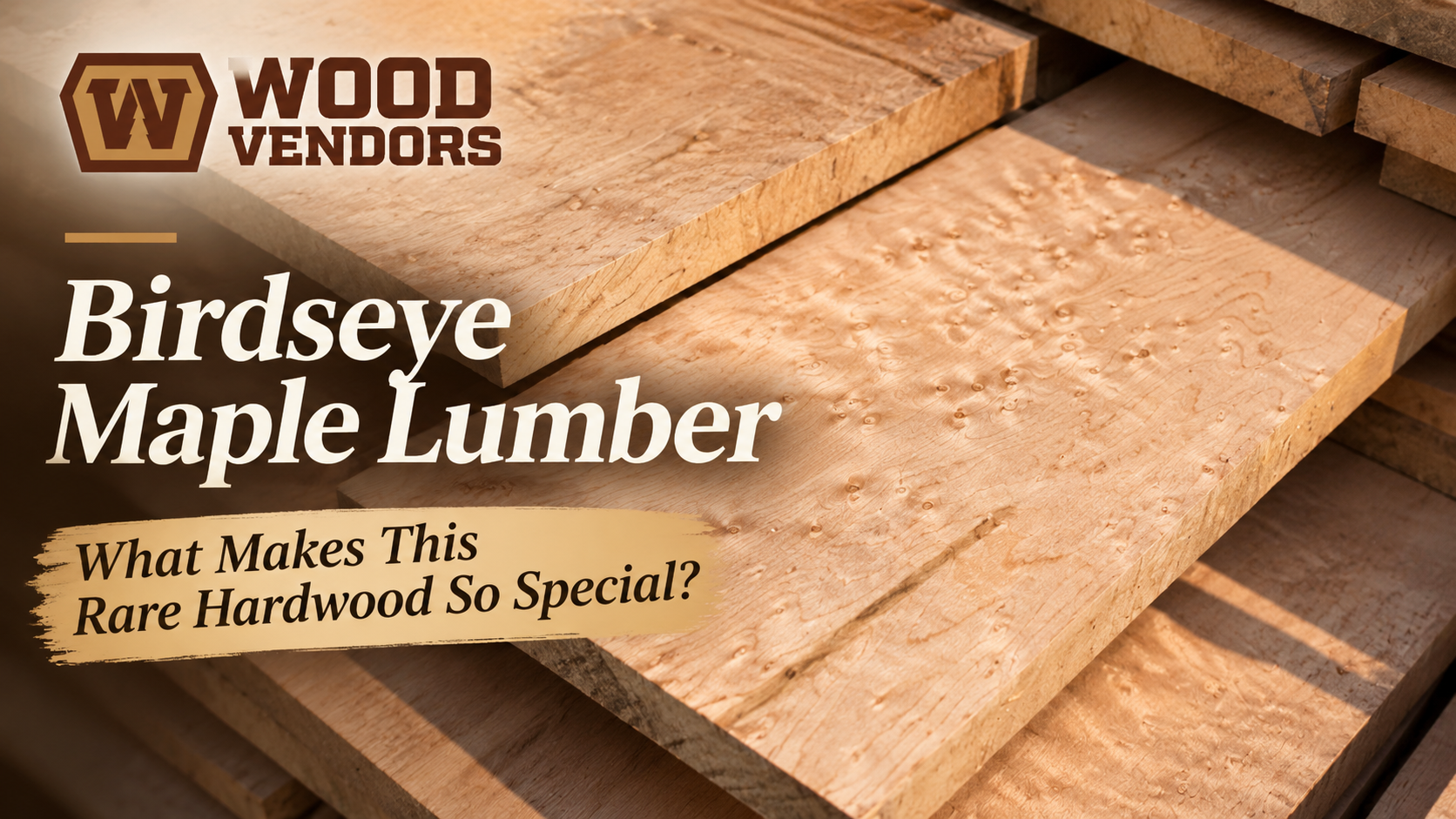
Birdseye Maple is one of North America’s most distinctive hardwoods, known for its unusual grain patterns and natural beauty. From fine furniture and cabinetry to musical instruments, this figured hardwood has captured the attention of craftsmen for generations.
But what exactly is Birdseye Maple, and what makes it so desirable?
What Is Birdseye Maple?
Birdseye Maple isn’t a separate species of wood. It’s a naturally occurring grain pattern most commonly found in Hard Maple (Sugar Maple).
Its name comes from the tiny, swirling patterns throughout the wood that resemble bird’s eyes. These markings can range from lightly scattered to densely concentrated, creating an almost three-dimensional appearance when finished.
Interestingly, the exact cause of Birdseye figure remains a mystery. Scientists have proposed theories involving genetics and growing conditions, but no single explanation has been conclusively established.
What Causes Birdseye Maple? Myths vs. Facts
One of the biggest mysteries surrounding Birdseye Maple is what actually causes its unusual grain. Despite years of research, scientists have yet to identify a definitive explanation.
Over time, several interesting theories have emerged, but not all have stood up to scientific scrutiny.
Bird Pecking: Early folklore suggested that birds pecking at maple trees caused the grain to twist into tiny eye-shaped patterns. Despite the name, there is no convincing scientific evidence supporting this theory.
Fungal or Viral Infections: Some researchers have suggested that fungi, viruses, or other biological disturbances might interfere with the tree’s growth. However, none has been established as the primary cause of Birdseye figure.
Genetics vs. Environment: Birdseye Maple is often associated with northern hardwood forests, including parts of Michigan, Maine, and Canada. Researchers have explored whether genetics, growing conditions, or environmental stress contribute to its formation, but the relationship remains unclear.
The interesting part? Birdseye figuring cannot currently be reliably reproduced on demand. Its unpredictable occurrence is one reason heavily figured Birdseye Maple remains so desirable.
Unlike spalted maple, which develops its characteristic discoloration through fungal activity, Birdseye Maple is distinguished by its unusual grain structure rather than fungal staining.
Why Is Birdseye Maple So Popular?
Birdseye Maple offers the strength and durability of Hard Maple with a decorative appearance that sets it apart from ordinary straight-grained lumber.
Popular uses include:
-
Fine furniture: Tables, desks, dressers, and custom pieces
-
Cabinetry: Cabinet doors, drawer fronts, and decorative panels
-
Musical instruments: Guitar necks and specialty components
-
Architectural millwork: Wall panels, trim, and luxury interiors
-
Specialty woodworking: Jewelry boxes, pool cues, and decorative projects
Although Birdseye Maple shares the basic properties of regular Hard Maple, its irregular grain can require extra care when machining and finishing.
A Little History of Birdseye Maple
Birdseye Maple has been appreciated in American woodworking for centuries. During the 18th and 19th centuries, cabinetmakers used figured maple in decorative furniture to showcase their craftsmanship.
Its popularity eventually extended beyond furniture into musical instruments, decorative veneers, and even luxury automobile interiors.
Did You Know? Interesting Birdseye Maple Facts
-
It’s exceptionally rare. Some estimates suggest Birdseye figure occurs in fewer than 1% of Sugar Maple trees, although the exact frequency is uncertain.
-
It comes from a familiar tree. Sugar Maple is also the species famous for producing maple syrup.
-
The way it’s cut matters. Flatsawn surfaces generally display Birdseye patterns more prominently than quartersawn surfaces.
Why Is Birdseye Maple More Expensive?
Not all Birdseye Maple lumber is valued equally. Pricing depends on several factors:
-
Figure intensity: Dense, consistent Birdseye patterns typically command higher prices.
-
Board dimensions: Longer and wider boards are often more desirable.
-
Quality: Color, defects, and usable yield influence value.
-
Availability: Heavily figured material can be difficult to source consistently.
These characteristics make Birdseye Maple a specialty hardwood that often sells at a premium compared to standard Hard Maple.
Birdseye Maple Lumber at Wood Vendors
At Wood Vendors, we source specialty hardwood lumber for woodworkers, cabinetmakers, furniture manufacturers, and lumber buyers nationwide.
We just received 4/4 Birdseye Maple with medium-to-heavy figure, competitive pricing, and nationwide shipping options.
Whether you’re searching for a few boards or full packs of lumber, we’re happy to help you find the right material for your project.
Contact us for current inventory, pricing, photos, and availability.
Wood Vendors
WoodVendors.com
[email protected]
1-877-983-6367